8th Pay Commission: 3 Major DA Proposals That Could Change Salary and Pension Calculations
Employee and pensioner groups have proposed quarterly DA revisions, a 25% DA merger, and tax-free DA under the 8th Pay Commission. Here is an in-depth breakdown of what these demands mean.
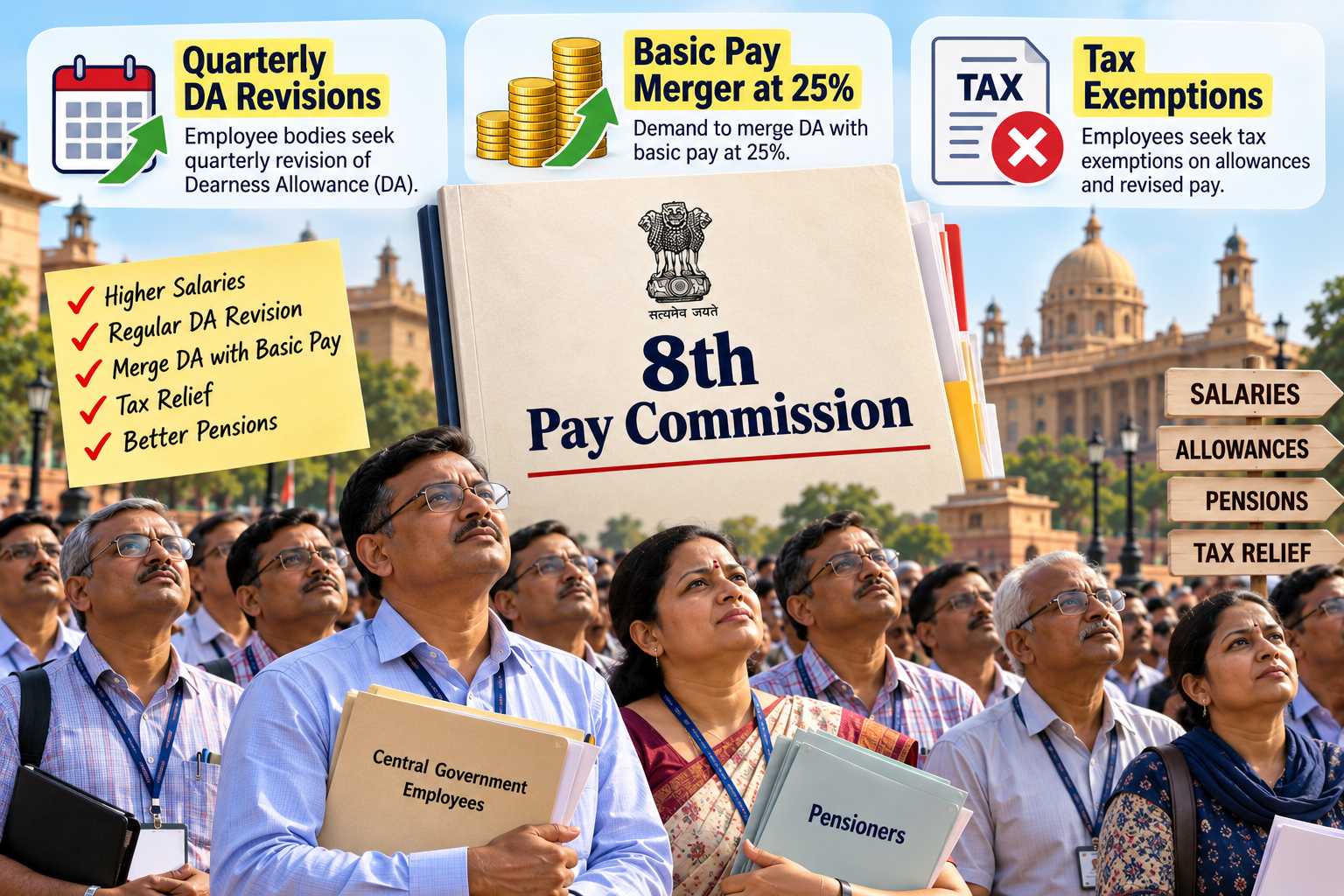
The 8th Central Pay Commission is actively reviewing representations, memorandums, and proposals related to revised salaries, pensions, and allowances. Alongside baseline demands for a higher fitment factor and an updated pay matrix, employee federations and pensioner associations have placed three significant reforms regarding Dearness Allowance (DA) and Dearness Relief (DR) before the commission.
Three key proposals have captured widespread attention among over 49 lakh central government employees and nearly 69 lakh pensioners:
- Quarterly review of DA/DR (every three months instead of bi-annually).
- Automatic merger of DA into Basic Pay once it crosses the 25% threshold.
- Exemption of DA and DR from Income Tax.
It is important to emphasize that these proposals represent formal representations submitted by staff associations and pensioner bodies; they remain under review and are not yet approved government policies.
What Is the Current DA & DR System?
Dearness Allowance (DA) is paid to central government employees to neutralize the erosion of real purchasing power caused by inflation. Pensioners receive an equivalent inflation-linked benefit known as Dearness Relief (DR).
Under the existing 7th Pay Commission framework:
- DA and DR are revised twice a year, effective from 1 January and 1 July, based on the 12-month average of the All-India Consumer Price Index for Industrial Workers (AICPI-IW).
- Employee unions contend that retail price fluctuations occur far more rapidly than bi-annual adjustments can capture, leaving employees and elderly pensioners vulnerable to price spikes during intervening months.
Proposal 1: Review DA and DR Every Three Months (Quarterly Revision)
The Bharat Pensioners Samaj (BPS) and multiple staff-side federations have formally requested the 8th CPC to introduce quarterly revisions for both DA and DR.
Under this proposal, inflation adjustments would take place four times a year (January, April, July, and October) instead of only twice:
- Why Unions Support It: Retail food and fuel inflation often surges unpredictably over a short period. A 3-month revision cycle would provide faster financial cushion against cost-of-living spikes.
- The Counter-Perspective: Quarterly revisions would increase administrative workload for the Ministry of Finance and require more frequent payroll adjustments across ministries, railways, and defense establishments.
Proposal 2: Automatic DA Merger with Basic Pay After Crossing 25%
Another structural demand submitted by postal and central employee unions (including the Federation of National Postal Organisations) proposes an automatic merger of DA into Basic Pay whenever DA crosses 25%.
For retirees, the corresponding representation calls for merging Dearness Relief (DR) into basic pension at the identical 25% threshold.
How Would a 25% DA Merger Work?
Consider an employee with an existing Basic Pay of ₹40,000:
- Current Basic Pay: ₹40,000
- 25% DA portion: ₹10,000
- Revised Basic Pay upon Merger: ₹50,000 (
₹40,000 + ₹10,000) - Subsequent DA resets to 0% on the enhanced ₹50,000 base.
By permanently elevating the basic pay base, subsequent calculations for House Rent Allowance (HRA), Transport Allowance (TA), retirement gratuity, and ultimate pension would all see substantial, compounding increases.
Calculate Your 8th Pay Commission Salary & Estimated Arrears
Estimate your revised basic pay, allowances, and prospective retrospective arrears from 1 January 2026 across different fitment factor scenarios:
Proposal 3: Exempt DA and DR from Income Tax
A third critical proposal addresses the tax treatment of dearness compensation. Employee associations argue that because DA is merely a compensatory mechanism designed to offset inflation—rather than real salary enhancement—it should be fully exempt from Income Tax.
- The Union Argument: When employees enter higher tax brackets (30% slab under the Old or New Tax Regime), nearly a third of their cost-of-living allowance is clawed back in taxes, defeating the purpose of inflation neutralization.
- The Fiscal Hurdle: Exempting DA from tax would require statutory amendments to the Income Tax Act and would cause a massive recurring revenue dent in central direct tax receipts.
Summary Comparison: Current Rule vs. Proposed Reform
| Feature | Current 7th CPC Framework | Proposed 8th CPC Reform | Primary Benefit to Employees / Pensioners |
|---|---|---|---|
| Revision Frequency | Bi-annual (January & July) | Quarterly (4 times a year) | Quicker protection against sudden inflation spikes. |
| Merger Threshold | No automatic merger rule | Automatic merger at 25% DA/DR | Higher baseline for HRA, gratuity, and pension calculations. |
| Tax Status | 100% Taxable as salary income | Tax-Free Allowance | Significantly higher take-home pay, especially for senior brackets. |
| Pensioner Parity | DR revised alongside DA | Parallel quarterly DR & merger | Equal protection for retirees facing healthcare and living costs. |
What Is the Current Status of the 8th Pay Commission?
The 8th Central Pay Commission was formally constituted on 3 November 2025, chaired by Justice Ranjana Prakash Desai. The commission has been granted an 18-month tenure to conduct stakeholder hearings, evaluate macroeconomic data, and submit its recommendations to the Union Government.
Its comprehensive terms of reference encompass:
- Minimum wage determination and new Pay Matrix levels.
- Uniform Fitment Factor formulation (demands ranging between 1.92× and 2.86×).
- Allowances and DA calculation formulas.
- Pension parity, commutation, and Unified Pension Scheme (UPS) integration.
Are These DA Proposals Confirmed by the Government?
No. It is crucial for central government employees and pensioners to distinguish between union representations and official policy:
- Submission Stage: These three proposals have been submitted as part of staff memorandums.
- Evaluation Stage: The 8th Pay Commission will evaluate the fiscal sustainability and administrative viability of each proposal.
- Cabinet Notification: Only those recommendations formally accepted by the Union Cabinet and published via Gazette Notification by the Department of Expenditure (DoE) will take effect.
Conclusion
The proposals for quarterly DA revisions, a 25% automatic merger threshold, and tax exemption reflect the genuine concerns of government employees grappling with long intervals between pay commissions. While they offer substantial financial relief on paper, their adoption hinges on the 8th CPC’s upcoming report and Cabinet approval.
Stay informed with authentic updates and run your own pay projections using our 8th Pay Commission Salary Calculator and Arrears Calculator.
Frequently Asked Questions (FAQs)
1. What are the three major DA proposals submitted to the 8th Pay Commission?
The three key proposals submitted by employee and pensioner federations are: quarterly DA/DR revisions (every 3 months), automatic merger of DA into basic pay once it reaches 25%, and making DA tax-free.
2. Has the government approved quarterly DA revisions?
No. The proposal is currently under review by the 8th Central Pay Commission and has not received official government approval.
3. How would a 25% DA merger benefit employees?
Merging 25% DA into Basic Pay increases the base salary, which automatically elevates other allowances calculated as a percentage of basic pay—such as House Rent Allowance (HRA), retirement gratuity, and future pensions.
4. Is Dearness Allowance currently tax-free?
No. Under current Income Tax regulations, Dearness Allowance is fully taxable as part of salary income under “Salaries”.
5. When will the 8th Pay Commission submit its report?
The commission was constituted in November 2025 with an 18-month timeline, making mid-2027 the expected submission timeframe.