8th Pay Commission Arrears From January 2026? What Employees Need to Know
Will central government employees receive 8th Pay Commission arrears from January 2026? Understand the effective date, 18-month timeline, fitment factor rules, and arrear calculation formula.
The possibility of 8th Pay Commission arrears from January 2026 has emerged as one of the most widely debated questions among more than 49 lakh central government employees and over 68 lakh pensioners. While 1 January 2026 is universally cited by employee federations as the natural effective date following India’s traditional 10-year pay revision cycle, the Central Government has not yet officially confirmed either the final implementation date or the statutory arrears payment formula.
Understanding the difference between an expected effective date and an actual notification date is critical. If the government approves recommendations with retrospective effect from 1 January 2026, employees will receive cumulative arrears for every intervening month until the revised pay matrix is credited to their bank accounts.
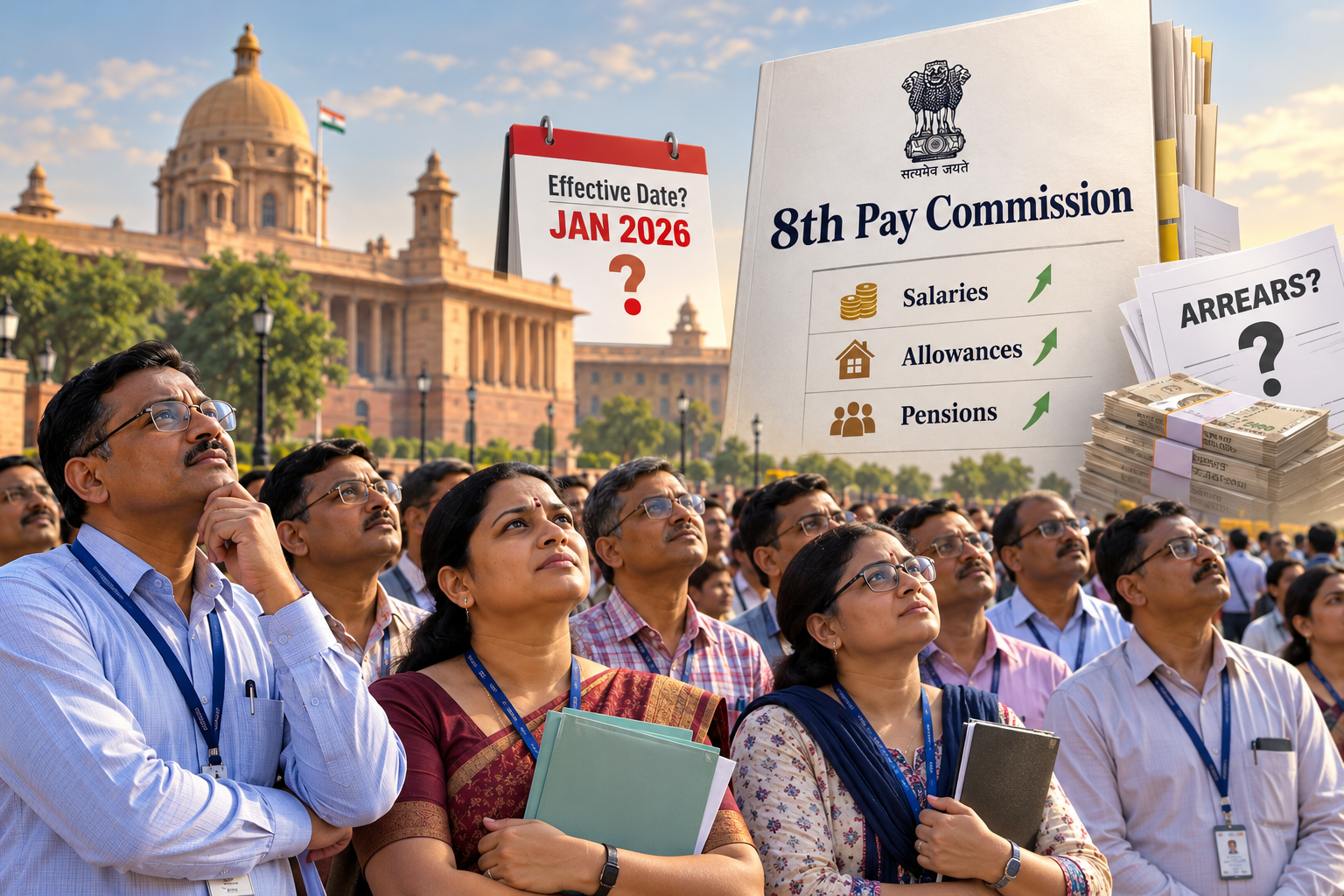
Is January 1, 2026 the Confirmed Effective Date?
Not yet. January 1, 2026 is linked to the historical 10-year interval observed by Central Pay Commissions (CPCs):
- 5th Pay Commission: Implemented with effect from 1 January 1996
- 6th Pay Commission: Implemented with effect from 1 January 2006
- 7th Pay Commission: Implemented with effect from 1 January 2016
Because the 7th CPC completed its 10-year span on 31 December 2025, staff sides—led by the National Council (NC-JCM)—have formally urged the Centre to adhere to 1 January 2026 as the benchmark effective date.
However, an expected reference date does not constitute a legally binding order. The formal effective date only becomes statutory when the Union Cabinet reviews the commission’s final report, approves the revised pay structure, and issues an official Gazette Notification through the Ministry of Finance Department of Expenditure (DoE).
Why the Effective Date Determines Your Arrears
The gap between the effective date (when the new pay scale begins on paper) and the implementation date (when the revised salary is first disbursed by payroll) determines whether arrears arise and how large they will be:
| Scenario | Government Decision on Effective Date | Actual Disbursement Timeline | Arrears Status |
|---|---|---|---|
| Scenario A: Retrospective (Historical Precedent) | Approved from 1 January 2026 | Mid-to-Late 2027 (e.g., after Cabinet clearance) | Full Arrears Paid for all intervening months (18 to 24 months of pay difference). |
| Scenario B: Prospective (Immediate Date) | Approved only from the date of Gazette notification | Month following Cabinet notification | No Retrospective Arrears for earlier months; revised pay begins only going forward. |
| Scenario C: Staggered Allowances | Basic pay retrospective from 1 January 2026; Allowances prospective | Staggered implementation | Arrears paid on Basic Pay + DA difference only; allowances (HRA, TA) start without retrospective arrears. |
In both the 6th and 7th Pay Commissions, the Union Government adopted Scenario C: revised basic pay and dearness allowance were made retrospective from 1 January of the respective decade, while revised allowances were notified prospectively.
How Could 8th Pay Commission Arrears Be Calculated?
Arrears represent the net difference between what an employee should have received under the approved 8th CPC structure and what was actually paid under the existing 7th CPC framework during the delay period.
A standardized calculation formula comprises the following steps:
- Current 7th CPC Basic Pay: Your existing basic pay on Level 1 through Level 18.
- Approved Fitment Factor: The uniform multiplier (such as 2.15×, 2.28×, or 2.57×) approved by Cabinet.
- Revised 8th CPC Basic Pay:
Current Basic Pay × Fitment Factor(rounded off to the next ₹100 per pay matrix standards). - Monthly Basic Difference:
Revised Basic Pay − Current Basic Pay. - Net DA & Allowance Adjustment: Re-evaluating applicable Dearness Allowance (DA) and Dearness Relief (DR) against the newly established base.
- Total Gross Arrears:
(Monthly Pay Difference + DA Difference) × Number of Delayed Months.
Illustrative Arrears Calculation (Basic Pay Difference)
| Pay Band / Level | Existing 7th CPC Basic Pay | Est. 8th CPC Basic Pay (at 2.28×) | Monthly Basic Difference | Est. 18-Month Gross Arrears | Est. 24-Month Gross Arrears |
|---|---|---|---|---|---|
| Level 1 (Entry) | ₹18,000 | ₹41,100 | ₹23,100 | ₹4,15,800 | ₹5,54,400 |
| Level 6 (Graduate / JE) | ₹35,400 | ₹80,800 | ₹45,400 | ₹8,17,200 | ₹10,89,600 |
| Level 7 (ASO / Inspector) | ₹44,900 | ₹1,02,400 | ₹57,500 | ₹10,35,000 | ₹13,80,000 |
| Level 10 (Group A Entry) | ₹56,100 | ₹1,28,000 | ₹71,900 | ₹12,94,200 | ₹17,25,600 |
(Note: Above figures represent basic pay differential estimates before statutory tax deductions and DA adjustments. For a granular breakdown across Levels 6, 7, and 8, see our dedicated analysis on Level 6 to 8 Arrears Calculation.)
Calculate Your 8th Pay Commission Salary & Estimated Arrears
Find out your prospective monthly revised basic pay, in-hand salary, and cumulative retrospective arrears from 1 January 2026 using our dedicated calculators:
Fitment Factor Will Direct the Final Quantum
The fitment factor is the primary multiplier used to transition basic pay from the 7th CPC to the 8th CPC Pay Matrix. However, employees must distinguish between a fitment multiplier and a direct percentage increase in take-home pay:
- DA Neutralization: When a new pay commission is implemented, the accumulated Dearness Allowance (DA)—which reached 63% in late 2026—is merged into basic pay.
- The Real Net Hike: If a fitment factor of 2.28× is approved, a significant portion absorbs the accumulated DA, resulting in an estimated real net basic pay increase of approximately 25% to 35%, rather than an outright 128% jump in total earnings.
- Impact on Arrears: A higher multiplier (such as union-demanded 2.86× or 3.833×) sharply increases the monthly basic differential, whereas an analyst-projected conservative range (2.15× to 2.57×) leads to moderate, fiscally sustainable arrears. Track real-time estimates on our Fitment Factor Tracker.
What Preceding Pay Commissions Reveal About Timelines
Historical precedents from earlier pay commissions illustrate that report submission and final notification timelines rarely follow an instant schedule:
- 5th Pay Commission (1996): Experienced substantial procedural extensions; arrears were ultimately disbursed in annual instalments to minimize fiscal disruption.
- 6th Pay Commission (2006): Constituted in October 2006, submitted in March 2008; benefits were made retrospective from 1 January 2006, resulting in over 32 months of arrears paid across two financial years (40% upfront and 60% in the subsequent fiscal year).
- 7th Pay Commission (2016): Report submitted in November 2015 and notified in July 2016; retrospective from 1 January 2016, giving employees 7 to 8 months of arrears in a single lump-sum payout.
These empirical records prove that an 18-month reporting window places the 8th CPC submission near May 2027, making 18 to 24 months of prospective arrears a realistic planning baseline if 1 January 2026 remains the retrospective start. Review full milestones in the 8th CPC Implementation Timeline.
The 6-Stage Government Approval Process
Employees often assume that once the Pay Commission hands its report to the Finance Ministry, revisions reflect in next month’s payroll. In practice, the administrative journey spans 4 to 8 months across 6 distinct checkpoints:
- Formal Submission: The Commission submits its multi-volume recommendations to the Union Finance Minister and Prime Minister.
- Departmental Screening: The Department of Expenditure (DoE) and Department of Personnel and Training (DoPT) scrutinize fiscal outlays, pension liabilities, and administrative parity.
- Empowered Committee Review: An Empowered Committee of Secretaries (E-CoS) reviews employee federation representations and resolves anomalies.
- Cabinet Sanction: The Union Cabinet, chaired by the Prime Minister, formally approves the revised Pay Matrix, Fitment Factor, and effective date.
- Gazette Notification & OM: Ministry of Finance publishes the Revised Pay Rules in the Gazette of India.
- PAO & DDO Payroll Credit: Individual Pay & Accounts Offices (PAO) and Drawing & Disbursing Officers (DDO) calculate individual service records and disburse updated pay and arrears.
Will Central Government Pensioners Also Receive Arrears?
Yes. Over 68 lakh central government pensioners and family pensioners are entitled to retrospective pension revision whenever serving employees receive revised pay:
- Pension Revision Mechanism: Past pensions are recalibrated using either the consolidated fitment factor method or notional pay fixation under the revised matrix (see our dedicated Pensioners Hub).
- Dearness Relief (DR) Arrears: Pensioners receive arrears on the difference between revised basic pension and existing basic pension, alongside applicable DR adjustments.
- Commutation Rules: Whether commutation values will be recalculated retrospectively depends strictly on the final rules notified by the Ministry of Personnel and Pensions.
Key Takeaways for Central Government Employees
- January 2026 is an Expected Target, Not a Guarantee: Treat 1 January 2026 as the benchmark standard of the 10-year convention until the Union Cabinet passes the official resolution.
- Await Official Notifications: Disregard unverified social media claims promising fixed lakhs in arrears; accurate sums depend on your exact basic pay and the officially notified fitment factor.
- Use Calculators as Indicative Planners: Utilize verified calculation tools to understand budget scenarios and projected tax implications on potential lump-sum arrears.
Frequently Asked Questions (FAQs)
1. Will central government employees definitely receive arrears from January 2026?
Arrears will be disbursed only if the Central Government formally accepts 1 January 2026 as the retrospective effective date in the final Gazette Notification. While past pay commissions have consistently honoured this 10-year cycle for basic pay, official confirmation is pending.
2. When is the 8th Pay Commission expected to submit its report?
Under the standard 18-month reporting window from its constitution, the Commission is scheduled to submit its recommendations around May 2027, although fast-track hearings or extensions could shift this timeline by a few months.
3. Does the fitment factor directly equal the salary hike percentage?
No. The fitment factor is applied to existing basic pay, but because it also absorbs accumulated Dearness Allowance (DA), the actual net hike in take-home pay is typically between 25% and 35%, depending on the approved multiplier.
4. Will allowances like HRA and TA be paid with retrospective arrears?
Historically, no. Under both the 6th and 7th Pay Commissions, retrospective arrears were paid strictly on Basic Pay and Dearness Allowance, whereas revised allowances (such as House Rent Allowance and Transport Allowance) took effect prospectively from the date of Cabinet notification.
5. Can pensioners expect 8th Pay Commission arrears?
Yes. Pensioners and family pensioners are entitled to revised pensions and DR arrears from the approved effective date, calculated using notional pay fixation or fitment factor parity.
6. Where can employees calculate their prospective salary and arrears?
Employees can use our verified 8th Pay Commission Salary Calculator and Arrears Calculator to test different fitment factor scenarios (2.15× to 2.57×) based on their specific 7th CPC basic pay.
Related Tools & In-Depth Resources
- 8th Pay Commission Salary Calculator — Estimate your revised basic pay, DA, HRA, and in-hand salary.
- Arrears Calculator — Model prospective arrears for 12, 18, or 24 months of delay from January 2026.
- Pay Level 6 to 8 Arrears Calculation Guide — In-depth mathematical breakdown for middle-management and supervisory staff.
- 7th vs 8th CPC Pay Matrix Comparison — Level-by-level pay slabs from Level 1 to Level 18.
- Fitment Factor Analysis & Demands — Union demands (3.833×) vs realistic government fiscal models (2.28×).
- Implementation Timeline Tracker — Historical comparison of CPC submission dates and Cabinet approvals.
- Central Government Pensioners Hub — Rules, DR announcements, and family pension fixation guides.